

What looks like a perfect medical office on paper can fail fast if the parking doesn’t work for patients, staff, and local code. Parking requirements for medical offices are one of the most overlooked feasibility factors in site selection, and one of the costliest when ignored.
This article covers how parking minimums are calculated, why medical uses demand more than standard office space, how ADA rules apply, and how to assess a site before you commit.
Before you review any property, it helps to have a clear answer to how much space you need for a medical practice, so square footage needs and parking capacity can be evaluated together from the start.
Parking Requirements for Medical Offices: The Basics
Medical offices consistently need more parking than standard commercial or professional office uses. The exact number depends on local zoning, the specific type of medical use, and how the jurisdiction classifies the practice.
A study of 50 U.S. medical office buildings found that 4.5 spaces per 1,000 gross square feet meets peak-hour demand in most cases.
That is a useful benchmark, but the actual code minimum may be higher or lower depending on the ordinance.
| Use Type | Typical Ratio | Notes |
| Standard office | 3.3–4 spaces/1,000 SF | Based on employee density |
| Medical office (general) | 4–5 spaces/1,000 SF | Patient turnover drives demand |
| High-turnover MOB | 4.8–5.0 spaces/1,000 SF | Multi-tenant, constant daily flow |
| ADA accessible spaces | Per total lot count | Separate from zoning minimum |
| Local zoning minimum | Varies by jurisdiction | Always verify with local code |
Why Medical Offices Usually Need More Parking Than General Office Space
A law firm and a primary care clinic of equal size do not generate the same parking demand. Medical practices bring patients, companions, and clinical staff in overlapping patterns throughout the day. That is the core difference.
Standard professional office buildings typically require 3.3 to 4 spaces per 1,000 square feet. The parking requirements for medical offices sit noticeably higher, at 4 to 5 or more, because of the constant patient movement throughout operating hours.
| Factor | Standard Office | Medical Office |
| Typical visit duration | 30–90 min | 15–45 min |
| Daily turnover | Low | High |
| Staff density | Moderate | High |
| Peak-hour demand | Predictable | Variable, mid-morning and afternoon |
| Parking pressure | Moderate | High |
How patient flow changes parking demand
Short appointments, late arrivals, and family escorts all overlap during peak hours. A busy primary care clinic with back-to-back 15-minute slots creates constant lot turnover. A specialist office with longer appointments holds spaces for extended periods.
Both scenarios put real pressure on the lot, just in different ways.
Why staff parking matters just as much as patient parking
Staff parking quietly consumes a large share of available spaces. A clinic with four providers, two nurses, and three administrative staff needs at least nine spaces before a single patient arrives.
Shift overlap and reserved physician spots reduce what is actually left for patients.
| Space Category | Common Underestimate | Practical Impact |
| Physician/provider | Reserved spots cut patient access | Allocate early in site review |
| Clinical and admin staff | Shift overlap doubles demand | Account for peak-hour staffing |
| Patient spaces | Shared with companions | Plan for more than solo arrivals |
| Accessible spaces | Often too few or mislocated | Verify ADA count separately |
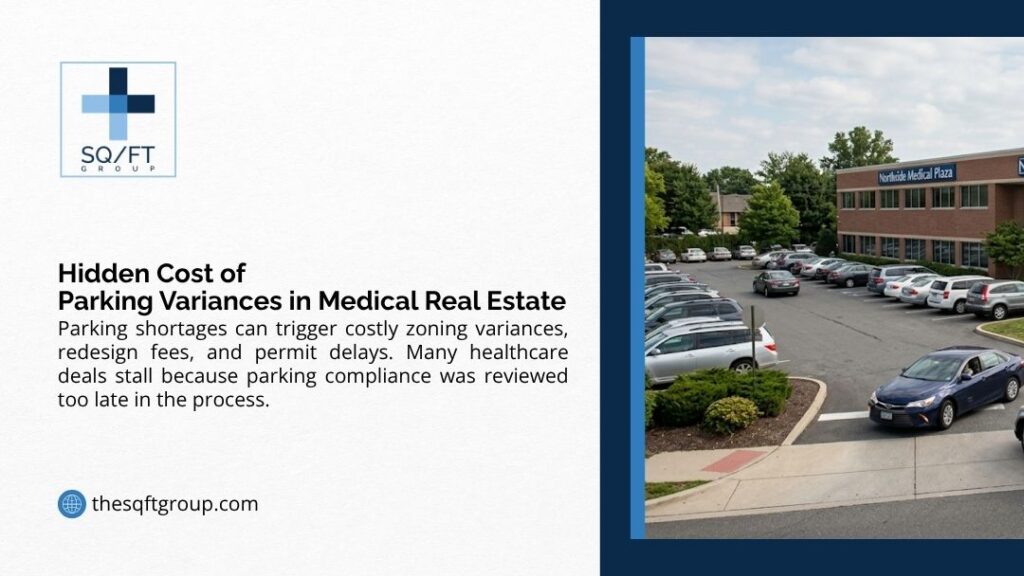
Local Zoning Ratios and Site-Specific Rules
The parking requirements for medical offices in one jurisdiction can be half the figure required just across the county line.
A general practitioner may be permitted in a standard commercial zone, while a surgical center might require a special medical or hospital zoning designation.
Some codes measure requirements by exam room count; others use square footage; some apply both and take the higher number. These figures must be verified against the actual local ordinance, not a general estimate.
| What to Check | Why It Matters | Who Should Verify | Risk If Ignored |
| Use classification | Clinic vs. office vs. outpatient | Broker or zoning attorney | Wrong ratio applied |
| Parking ratio formula | Per SF, per exam room, or per doctor | Local planning department | Shortfall found too late |
| Overlay districts | Some areas impose stricter standards | Code review | Permit denial |
| Shared parking eligibility | May reduce the required total | Site plan consultant | Missed cost opportunity |
Parking ratio examples by jurisdiction
A 2025 variance request in Jackson, Missouri shows how wide this range can be. The local code required either 4 spaces per 1,000 square feet or 4 spaces per exam room, whichever was higher.
For that clinic, the stricter method required 81 spaces; the square footage method required 47. The site had 48 spaces and had no room to expand, forcing a formal variance.
Knowing how to choose a location for a medical practice means checking local code at the start of any site review, well before a floor plan fails a basic parking analysis.
When a variance or redesign may be needed
If a site is close but not compliant, the available paths are shared parking agreements, lot redesigns that recover spaces, off-site parking with an access agreement, or a formal variance application. Each adds time and cost to the deal.
| Site Status | Recommended Next Step |
| Meets code | Proceed with standard review |
| Close but short by a few spaces | Explore shared parking or lot redesign |
| Significant shortfall | Variance required; cost-benefit analysis needed |
| Cannot meet code | Disqualify and move to the next site |
ADA Parking Rules for Medical Offices
ADA rules do not set the total number of spaces a site must have. That is a zoning question.
When working through parking requirements for medical offices, ADA is a separate calculation that governs the number of accessible spaces within whatever total the zoning code establishes.
The current federal standard is the 2010 ADA Standards for Accessible Design, which remains in effect today.
| Total Spaces in Lot | Required Accessible Spaces | Van-Accessible Required |
| 1–25 | 1 | 1 |
| 26–50 | 2 | 1 |
| 51–75 | 3 | 1 |
| 76–100 | 4 | 1 |
| 101–150 | 5 | 1 |
Parking requirements for medical offices and ADA overlap
Parking requirements for medical offices involve two separate layers: the total count set by zoning and the accessible count set by ADA.
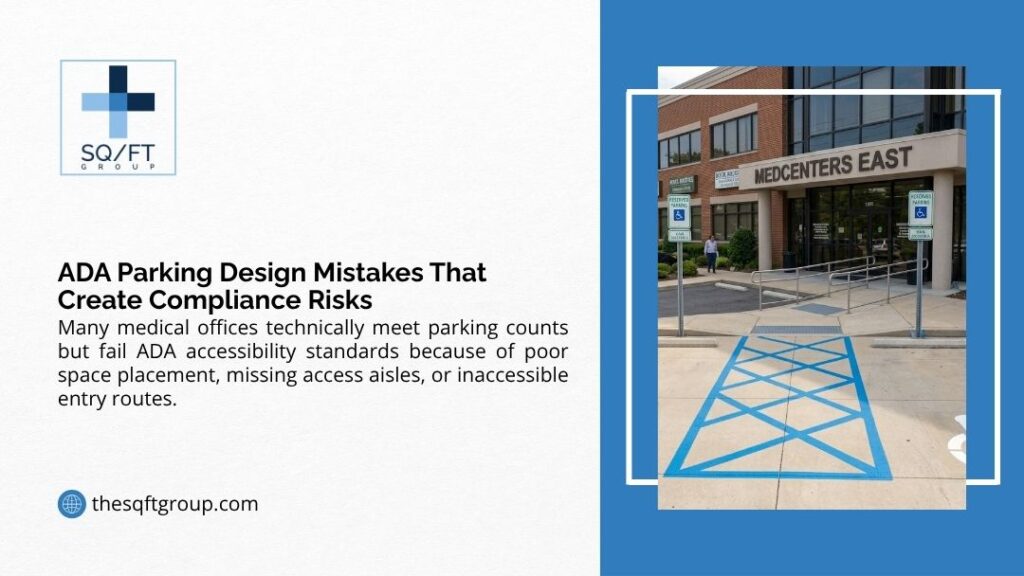
Meeting the parking minimum is not the same as meeting accessibility needs. A lot can be zoning-compliant and ADA non-compliant at the same time.
ADA also requires at least 1 of every 6 accessible spaces to be van-accessible, with a minimum access aisle width of 96 inches. All accessible spaces must connect to an accessible route that leads directly to the building entrance.
Common ADA mistakes to avoid
These are the most frequent compliance errors in medical office parking lots:
- Combining spaces across multiple lots on the same site instead of calculating accessible spaces per facility
- Providing standard accessible spaces with no van-accessible option
- Placing accessible spaces far from the main entrance with no accessible route in between
- Missing required access aisles adjacent to each accessible space
How to Judge Whether a Property Is Feasible Before You Sign
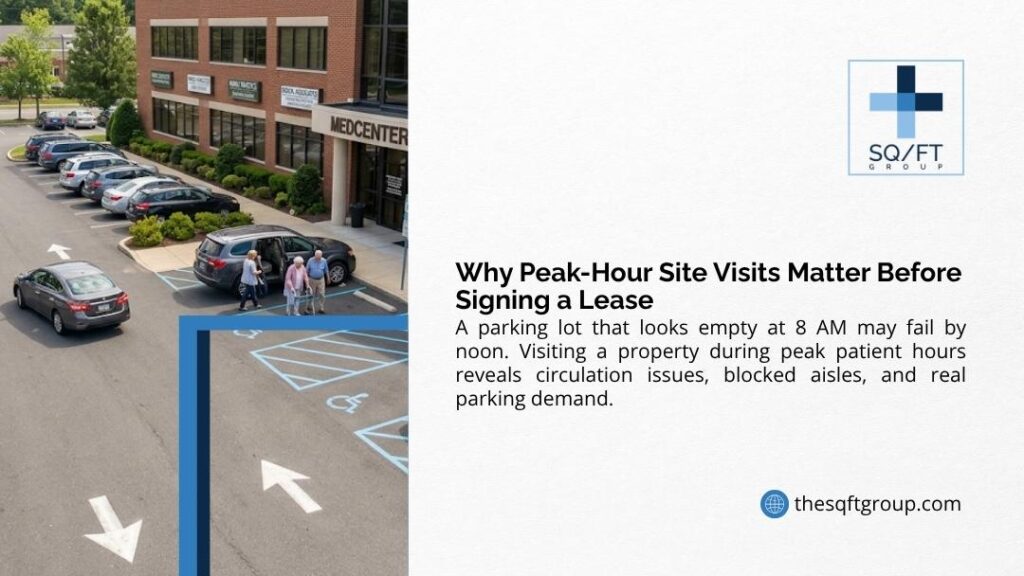
A site visit at the wrong time of day gives a false picture. Parking is one line item on a longer list, and our medical practice expansion checklist places it alongside every other step from space selection to grand opening. Evaluating parking requirements for medical offices before you sign means visiting during peak hours, counting occupied spaces, and observing how the lot functions under real demand. Parking is one section of the full site evaluation checklist, which also covers zoning permissions, floor plan fit, referral radius, and buildout exposure.
| Question to Ask | Why It Matters | Red Flag | Next Step |
| Total spaces vs. code requirement | Confirms basic compliance | Below minimum | Verify with local planning |
| Accessible space position | ADA compliance | Far from entrance | Redesign or reject site |
| Room for lot expansion | Future growth buffer | Zero room available | Factor into lease terms |
| Shared lots nearby | May offset a shortfall | No access agreements | Negotiate or move on |
What to check during a site visit
Walk the lot during mid-morning or early afternoon, when most clinics reach peak demand. Check traffic flow, the turning radius at the entrance, ADA signage, and whether the lot can handle simultaneous arrivals.
Note any double-park patterns or blocked aisles.
Signs the property may not work without changes
Watch for these red flags before you commit to anything:
- Lot dimensions too tight for standard-size spaces
- Shared parking with retail or office tenants that peak at the same hours
- No visible accessible route from the lot to the main entrance
- No room for a drop-off zone if the practice serves mobility-limited patients
Practical Parking Targets by Medical Office Type
Parking requirements for medical offices vary not just by jurisdiction but by the type of practice. A primary care clinic and a physical therapy office do not behave the same way, even at the same square footage.
| Practice Type | Visit Pattern | Parking Pressure | Risk Level |
| Primary care | Short, high-volume | High | High |
| Urgent care | Walk-in, unpredictable | Very high | Very high |
| Dental | Chair-based, moderate | Moderate-high | Medium |
| Physical therapy | Scheduled, 45–60 min | Moderate | Medium |
| Specialty clinic | Longer, lower volume | Lower | Low-medium |
| Imaging center | Appointment-heavy | Moderate | Medium |
High-turnover practices
Primary care clinics, urgent care centers, and multi-provider practices generate the most parking pressure. For dental offices, a widely used rule is 1.5 spaces per treatment chair plus one space per staff member.
These practices need lots that can handle rapid turnover and simultaneous arrivals without circulation problems.
Lower-turnover or appointment-heavy practices
Specialty practices like cardiology, orthopedics, or behavioral health have fewer daily appointments and longer per-visit times. The parking pressure is lower, but accessible space design carries more weight for patient populations with mobility limitations.
Frequently Asked Questions
How many parking spaces does a medical office need?
It depends on local zoning and the specific use. A study of 50 U.S. medical office buildings found that 4.5 spaces per 1,000 gross square feet meets peak-hour demand in most cases. Local codes may set different minimums, so verify with the local planning department.
Is medical office parking different from general office parking?
Yes, standard office space typically requires 3.3 to 4 spaces per 1,000 square feet. The parking requirements for medical offices are generally higher at 4 to 5 or more, driven by patient turnover, staff density, and accessibility needs.
Do ADA rules set the total number of parking spaces?
No, ADA governs accessible space requirements within the lot. Local zoning codes set the overall parking count. Both must be met, and they are calculated separately.
Can a property with enough square footage still fail parking requirements?
Yes, a site can have sufficient interior space but not enough usable, code-compliant parking. Lot configuration, shared-use conflicts, and ADA layout issues can all disqualify a property that otherwise looks right.
A Final Note Before You Commit
Parking is one of the first feasibility filters for any medical office site, and the problem rarely gets easier once lease negotiations are already in motion.
If you are evaluating a new location, a relocation, or a conversion from general office to medical use, the question of whether you should buy or lease medical office space belongs in that first feasibility conversation.
Parking capacity directly affects which structure makes the most practical sense for the site.
SQ/FT Commercial Brokerage works with healthcare providers across New York, New Jersey, and Connecticut on exactly these decisions.
With our experience in medical real estate, we support clients through site selection, parking feasibility, lease negotiation, and the full transaction process.
Contact SQ/FT Commercial Brokerage today for a consultation with a healthcare real estate specialist.