

“How long should a medical practice lease be”, is one of the first questions clinic owners face, and one of the most consequential.
Decisions like buying or leasing medical office space shape the entire framework before you even sit down with a landlord.
This article covers typical lease durations, the factors that influence the right term length, how to negotiate key provisions, and strategies to protect your practice from future operational shifts.
Typical Lease Lengths for Medical Practices
Most medical office leases fall into three broad duration categories. Each one carries a different risk profile, cost structure, and degree of operational flexibility.
| Lease Type | Duration | Best Suited For | Key Trade-off |
| Short-Term | 1 to 3 years | New or startup practices | Higher rent, less security |
| Medium-Term | 3 to 5 years | Growing established practices | Balanced risk and stability |
| Long-Term | 5 to 10+ years | Stable practices, high-demand locations | Lower rent, limited flexibility |
The right category depends on where your practice is in its development, how stable your patient volume is, and what your location demands. There is no universal correct answer, but there are clear patterns by practice type and market.
Short-Term Leases (1 to 3 Years)
Short-term leases suit new practices or clinics that are still validating a location. They give you the ability to exit or renegotiate before making a heavy long-term financial commitment.
The trade-off is cost. Landlords offer less favorable rent terms and smaller tenant improvement allowances on short leases because the return timeline is compressed.
For a startup clinic, this means absorbing more of the build-out cost upfront.
| Factor | Short-Term (1-3 Yrs) | Impact |
| Rent Rate | Often 10-15% above long-term rate | Higher monthly overhead |
| TIA Offered | Minimal or none | Tenant absorbs build-out cost |
| Relocation Risk | High at lease end | Patient base disruption possible |
| Exit Flexibility | High | Easier to move or renegotiate |
Short-term leases also carry relocation risk. If your lease does not renew on favorable terms, moving a medical practice disrupts continuity of care and risks patient loss, two outcomes worth planning around from day one.
Medium-Term Leases (3 to 5 Years)
The medium-term lease is the most common choice for established practices with a stable patient base and predictable revenue. It balances cost predictability with enough flexibility to reassess location and space needs at a reasonable interval.
A 3 to 5 year term with one or two renewal options is a practical structure for most general practice physicians, family medicine clinics, and outpatient therapy providers.
The renewal options extend your effective timeline while preserving your right to exit if the location or building no longer serves your needs.
How long should a medical practice lease be at this stage? For most providers with 2 to 4 years of operation and steady volume, a 3 to 5 year initial term with renewal options is often the most defensible answer.
Long-Term Leases (5 to 10+ Years)
Long-term leases make sense when the practice is stable, the location is high-demand, and significant capital will go into medical-grade build-out.
Specialty practices, such as surgical centers, imaging facilities, and multi-specialty groups, often sign 7 to 10 year leases because the infrastructure investment requires a long recovery window.
In competitive urban markets, a long-term lease also locks in below-future-market rent, which adds up to significant savings over time.
The risk is reduced flexibility. If your practice needs to expand beyond the leased space or contract due to staffing changes, a long lease without the right clauses can become a liability.
Key Factors Affecting Lease Duration
How long a medical practice lease should be is rarely determined by preference alone. Several operational and financial factors have a direct effect on the optimal term length.
| Factor | How It Affects Lease Duration | Recommended Lean |
| Location demand | High-demand areas warrant longer terms to lock in rent | Long-term (5-10 yrs) |
| Patient volume growth | Rapid growth may require more space sooner | Medium-term with expansion clause |
| Specialty equipment | Major infrastructure investment favors longer terms | Long-term (7-10 yrs) |
| Practice stage | New practices need lower risk and easier exits | Short to medium-term |
| Cash flow stability | Predictable revenue supports longer commitments | Medium to long-term |

Location and Patient Demographics
Location is one of the most influential variables in lease term decisions. A high-foot-traffic corridor near a hospital, senior community, or residential growth area has strong long-term demand.
Locking in that location for 7 to 10 years is often worth the reduced flexibility.
Secondary or developing locations carry more uncertainty. Before committing to any term length, reviewing how to choose a location for a medical practice helps confirm that the site matches your patient demographics and growth projections before you sign.
Practice Growth and Expansion Plans
A practice that expects to add providers, expand services, or grow patient volume within three years should not sign a long lease on a fixed-size space without an expansion clause.
Rapid growth in a space you cannot modify creates operational bottlenecks that affect both staff and patient experience.
Conversely, a mature practice with a capped patient panel and no near-term plans for expansion can commit to a longer lease with more confidence. Growth trajectory is one of the clearest signals for how long a medical practice lease should be.
Financial Considerations
Rent escalation clauses, tenant improvement allowances, and personal guarantee terms all affect the real financial weight of any lease term. A long lease with uncapped annual escalations can cost significantly more than a shorter lease with a fixed rate.
For practices that require specialized medical build-out, tenant improvement allowances for dental offices outlines how TIA structures work and what landlords typically offer, which applies directly to medical office negotiations as well.
As a general rule: the longer the term, the stronger your negotiating position for TIA, free rent periods, and escalation caps. Use that leverage.
Negotiating Medical Office Lease Terms
Lease terms are not fixed. Every clause in a medical office lease can be negotiated, and the landlord’s first draft is a starting position, not a final offer. The items below consistently have the most room for meaningful concessions.
| Clause | Benefit to Tenant | Risk if Skipped |
| Renewal option | Locks in your right to stay at pre-agreed rate | Forced relocation or sharp rent increase |
| Early exit clause | Exit after year 3-5 with notice period | Trapped in space that no longer fits your needs |
| Rent escalation cap | Limits annual rent increase (e.g., 2-3% or CPI-tied) | Unpredictable cost spikes mid-lease |
| TIA clause | Landlord contributes to medical build-out costs | Full build-out cost borne by tenant |
| Sublease rights | Option to share or transfer space if volume drops | Stuck paying full rent on unused space |
Renewal and Exit Options
A renewal option is one of the highest-value clauses in any medical lease. It secures your right to stay at a pre-agreed rent range and eliminates the risk of losing a well-established location at the end of your term.
Negotiate at least two renewal options of three to five years each. Early exit clauses are increasingly standard in post-2020 commercial leases.
A provision allowing exit after year three or five with six to twelve months notice provides meaningful protection if your practice changes direction.
For practices in the dental sector, how to negotiate a dental office lease covers the full negotiation sequence in detail, including personal guarantee structures and exclusivity clauses that apply equally to medical office tenants.
Subleasing or Shared Space
Sublease rights give a practice the ability to offset rent by sharing space with a compatible provider, or to exit a portion of the lease if patient volume drops. This is a practical hedge for practices that are uncertain about long-term space needs.
Shared medical space arrangements, where two or more providers split a suite on alternating schedules, are increasingly common in markets where per-square-foot costs are high.
Confirming this option is permitted under your lease before signing is critical.
Rent Escalations and Hidden Costs
Annual rent escalation clauses of 3 to 5 percent are common in landlord-drafted leases. Over a 10-year term, a 4 percent annual increase on a $6,000 per month base adds more than $300,000 to total occupancy cost compared to a 2 percent cap.
Beyond base rent, review triple-net (NNN) charges, CAM fees, and utility responsibilities carefully.
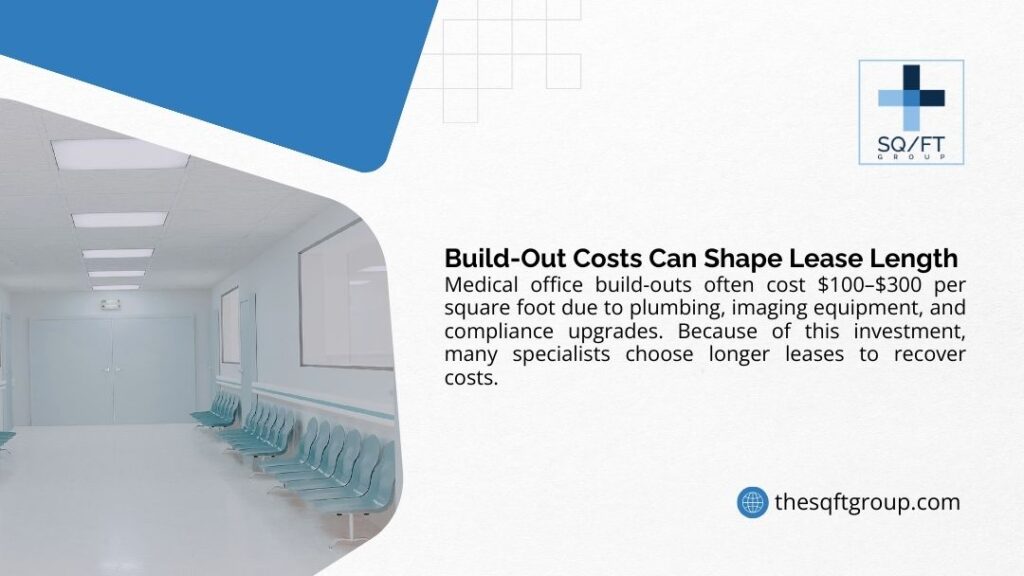
Medical spaces often carry higher utility loads due to HVAC requirements, sterilization equipment, and extended operating hours, costs that may not be fully reflected in headline rent figures.
Future-Proofing Your Medical Office Lease
How long a medical practice lease should be is only part of the question. The structure of that lease, the clauses it contains, and the provisions it protects against determine whether it serves your practice well over time.
| Strategy | What It Protects Against | How to Secure It |
| Expansion rights clause | Space shortfall as patient volume grows | Negotiate first right of refusal on adjacent units |
| Downsizing option | Paying for unused space if volume drops | Include a square footage reduction clause |
| Telehealth-ready lease | Over-committing to physical space you may not need | Negotiate flexible term length with hybrid space options |
| ADA and zoning review | Compliance costs passed to tenant post-signing | Clarify responsibility in lease before signature |
Planning for Telehealth and Hybrid Operations
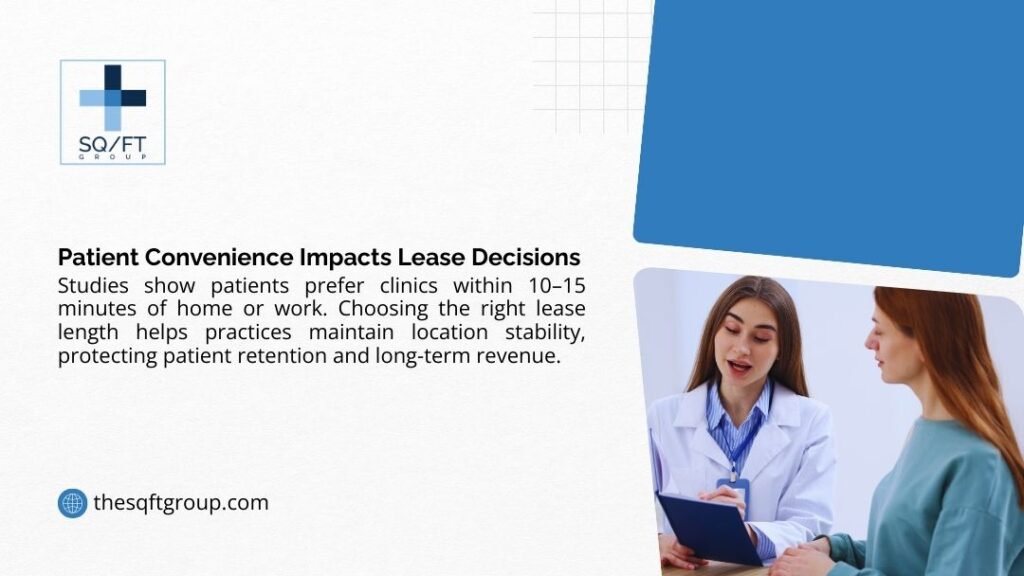
Telehealth adoption has changed how many practices use physical space. A clinic that ran 40 in-person appointments per day in 2019 may now operate a hybrid model that requires fewer exam rooms but more private consultation space for virtual visits.
Before committing to how long your medical practice lease should be, assess what proportion of your patient volume is likely to remain in-person over the next five to seven years.
Locking into a large footprint based on pre-telehealth patient flow can result in paying for space your care model no longer needs.
Expansion or Downsizing Options
A right of first refusal on adjacent space is one of the most practical tools for practices that expect growth. It gives you the option to expand into neighboring units without renegotiating your core lease or relocating entirely. If expansion is already on the horizon, this checklist for expanding a medical practice outlines the sequence of decisions that follow a right of first refusal.
Before finalizing any lease term, confirming that the space can physically support your near-term growth is essential. Reviewing how much space a medical practice needs helps you establish the right square footage baseline before you commit to a term length.
Legal and Compliance Considerations
Medical office leases carry compliance obligations that standard commercial leases do not.
ADA accessibility requirements, medical zoning restrictions, biohazard waste handling, HIPAA-related privacy modifications, and fire suppression standards all affect the physical space and may trigger landlord-tenant cost disputes if not addressed in the lease.
Clarify before signing who is responsible for compliance upgrades if regulations change during the lease term. In many standard leases, this responsibility defaults to the tenant. Before you negotiate who pays for what, review the HIPAA-compliant layout requirements room by room so you know which privacy modifications your space will actually need.
Negotiate to cap your exposure or allocate major structural compliance costs to the landlord.
Frequently Asked Questions
How does practice growth affect the optimal lease length?
A practice with rapid patient volume growth needs flexibility to expand or relocate sooner. In that case, a medium-term lease with an expansion clause and renewal options is preferable to a long fixed-term commitment on a space that may become too small within three years.
Can I negotiate an early exit clause in a medical office lease?
Early exit clauses are a standard negotiation point in most commercial leases and are increasingly common in medical office agreements. A typical structure allows exit after year three or five with six to twelve months of written notice. Landlords may require a termination fee, but this is negotiable.
What is the risk of signing a very long lease in an uncertain market?
A long lease without flexibility clauses creates exposure if your practice downsizes, relocates, or faces financial pressure. The main risks are paying above-market rent if rates drop, being unable to exit without penalty, and losing operational agility. Mitigate this with renewal options, sublease rights, and an early exit provision.
How do subleasing or shared spaces affect lease planning?
Sublease rights allow you to bring in another provider to share costs or to transfer the lease if you exit the practice. Without this clause, you may remain financially responsible for rent even after vacating the space. For practices with variable patient volume, sublease rights are one of the most practical protections available.
Key Takeaway
How long a medical practice lease should be depends on practice stage, location demand, financial stability, and how much space required in medical-grade build-out. Short-term leases suit new practices that need flexibility.
Medium-term leases work best for growing practices that want predictability without locking in for a decade. Long-term leases serve stable, high-volume practices in competitive markets where securing the location long-term has clear financial value. Term length also shapes your exit, so review how a lease affects a practice sale before committing to a decade in one space.
Every lease, regardless of term length, should include renewal options, an escalation cap, sublease rights, and clear compliance responsibilities. These are not optional protections. They are the baseline for any well-structured medical office agreement.
Work with a Brokerage That Specializes in Medical Office Leasing
At SQ/FT Commercial Brokerage, we represent healthcare tenants across New York, New Jersey, Connecticut, and the broader New England region. Our team works exclusively in commercial real estate with a deep focus on healthcare property needs.
We handle site selection, lease negotiation, and transaction management so you can focus on patient care. Our tenant representation service is paid by the landlord, which means professional guidance at no direct cost to your practice.
Contact SQ/FT Commercial Brokerage to discuss your medical office lease and find out what terms are available in your market.