

Are you a medical professional weighing whether to buy or lease your next practice location, but unsure which path actually protects your finances and long-term goals?
This guide breaks down everything you need to know about buying or leasing medical office space, from upfront costs and tax implications to practice stage strategy and a clear decision framework.
Why Choosing the Right Medical Office Space Matters
A poor real estate decision, whether that means overcommitting capital too early or locking into a space that limits growth, can put serious strain on a practice.
According to the Medical Group Management Association (MGMA), facility costs rank among the top overhead expenses for private practices, often representing 5% to 10% of annual revenue.
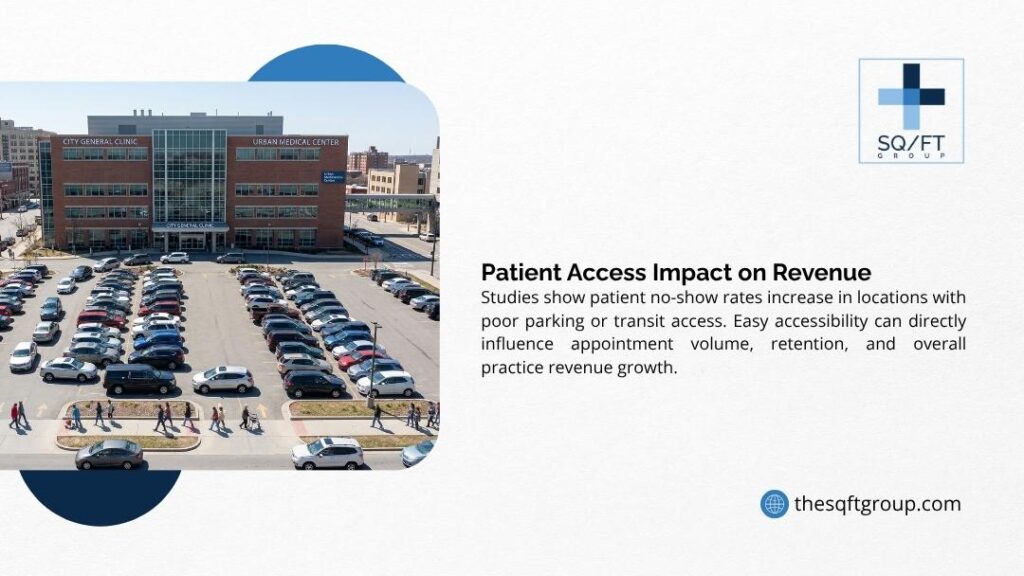
Beyond costs, location affects patient volume. Practices in areas with poor visibility, limited parking, or misaligned patient demographics tend to underperform even when clinical quality is strong.
The real estate decision you make today will influence referral patterns, staff recruitment, and your exit strategy years down the line.
Key Differences Between Buying and Leasing Medical Office Space
The core question of “should I buy or lease medical office space” comes down to three things: capital availability, flexibility needs, and long-term commitment.
Both paths come with real advantages. Both come with real trade-offs. The right choice depends entirely on your specific practice situation.
| Factor | Buying | Leasing |
| Upfront Cost | High (down payment + closing costs) | Low (security deposit + first month) |
| Monthly Expense | Mortgage + taxes + insurance + maintenance | Rent (NNN or gross, depending on lease type) |
| Equity | Builds over time | None |
| Flexibility | Low — must sell or rent to relocate | High — exit at lease end |
| Maintenance | Owner’s full responsibility | Landlord handles structural repairs |
| Tax Benefits | Mortgage interest deduction, depreciation | Rent fully deductible as business expense |
Pros of Buying
Ownership gives you control, so this means that you can renovate freely, install specialized medical equipment, and configure the layout without waiting for landlord approval.
Every mortgage payment builds equity, and if the property appreciates, your net worth grows alongside it.
Ownership also provides cost predictability over the long term. Your monthly payment does not increase the way rent does under escalation clauses once locked into a fixed-rate mortgage.
For established practices with stable revenue, buying a building through a separate entity and leasing it back to the practice is a common strategy. It builds personal wealth while keeping the practice and property legally distinct.
Cons of Buying
The upfront capital requirement is the biggest barrier. Between the down payment, closing costs, inspections, and medical-specific build-out, total initial costs can easily reach $150,000 or more depending on market and property conditions.
Ownership also reduces flexibility. If your practice grows faster than expected, relocates, or undergoes a partnership change, selling commercial real estate takes time and comes with transaction costs.
For newer practices still building their patient base, tying up that much capital in real estate before the business model is proven adds unnecessary risk.
Pros of Leasing
Leasing preserves working capital. The money not spent on a down payment stays available for staffing, equipment, marketing, and operations, all are very important during the early growth phase.
Monthly costs are more predictable in the short term, and major structural maintenance falls on the landlord. For practices that are still testing a location or expect growth-driven relocation within five to seven years, leasing offers a clean exit.When thinking about how long a medical practice lease should be, most standard agreements run five to ten years with renewal options.

Cons of Leasing
No equity is the primary downside. Every rent payment goes to the landlord, not toward ownership. Over a 15-year period, the cumulative cost of leasing often exceeds the total cost of buying in most U.S. markets.
Lease escalation clauses also add up, which are typically 2% to 4% annual increases. Triple net (NNN) leases shift property tax, insurance, and maintenance costs to the tenant, which can make the real monthly cost higher than the base rent suggests.
4 Factors to Consider Before Deciding
The decision about buying or leasing medical office space is not one-size-fits-all. Several practice-specific variables should guide your evaluation.
When thinking about the space needed for a medical practice, the answer depends on your service mix, projected patient volume, and staffing model.
| Factor | Buy | Lease | Notes |
| Practice Age | 8+ years | 0–7 years | Newer practices carry more uncertainty |
| Revenue Stability | Consistent 2+ years | Variable or early-stage | Stable revenue supports debt service |
| Growth Plan | Fixed location, long-term | Expansion or relocation likely | Leasing allows flexibility to scale |
| Relocation Flexibility | Low priority | High priority | Buying locks you to a specific address |
Practice Stage
Solo practitioners or new practices are almost always better served by leasing first.
The early years are for proving the model, building referral networks, and confirming that your chosen location supports patient volume. Buying before that data exists is a financial risk without sufficient justification.
Multi-provider or specialty clinics with established patient bases and predictable revenue are much stronger candidates for ownership. They have the cash flow to handle mortgage obligations and the stability to commit to a location long-term.
Financial Readiness
Before approaching a lender, review your financial position, including existing personal debts.
While commercial lenders focus primarily on the property’s ability to cover loan payments (typically looking for a Debt Service Coverage Ratio of at least 1.25), maintaining manageable personal debt helps ensure your application is strong.
SBA 7(a) and SBA 504 loans are both commonly used for medical office purchases and offer more favorable terms than conventional commercial mortgages for qualifying practices.
Keep three to six months of operating expenses in cash reserve after any down payment. Depleting liquidity to fund a purchase creates fragility in the event of a slow quarter or unexpected maintenance costs.
Market and Location Considerations
Patient demographics, population growth trends, and local competition all factor into location value. A lease gives you the ability to test a new area before committing capital to it, particularly valuable when a practice is expanding into a new market or specialty.
Zoning is also a practical consideration. Medical offices require proper commercial or professional use zoning, ADA compliance, and in some cases, specific permits for equipment like imaging or procedure rooms. Verify all of this before signing anything. The site criteria behind that decision stay the same whether you buy or lease, and we break them out property by property in a companion guide.
Long-Term Financial and Strategic Implications
The total cost picture changes significantly depending on your time horizon. Buying carries higher upfront costs, but the financial calculus often shifts after seven to ten years.
| Scenario | 5-Year Total Cost | 10-Year Total Cost | 15-Year Total Cost |
| Buying (with 3% appreciation) | Higher upfront, moderate total | Roughly comparable to leasing | Often lower than leasing total |
| Leasing (with 3% annual increases) | Lower upfront, moderate total | Roughly comparable to buying | Often higher than buying total |
Note: These projections are illustrative and vary by market, property type, loan terms, and rent escalation rates. Work with a CPA and a commercial real estate broker to model your specific scenario.
Tax Implications
Owners can deduct mortgage interest and depreciate the building over 39 years under current IRS rules for commercial real estate. These deductions reduce taxable income meaningfully in the early years of ownership when interest payments are highest.
Tenants deduct rent as a business expense, which are straightforward and often significant. In high-rent markets, the deductible amount can be comparable to an owner’s combined interest and depreciation deductions, especially in the first five years.
Neither option is automatically superior from a tax standpoint. The right answer depends on your income level, entity structure, and financial goals. A qualified CPA familiar with medical practice finances should run the numbers before you decide.
Practice Growth Scenarios
A practice that grows faster than projected may outgrow a purchased space, creating pressure to sell, renovate, or acquire additional square footage nearby.
A practice that underperforms may find mortgage obligations difficult to sustain without the flexibility a lease would have provided.
Step-By-Step Decision Framework
Step 1: Assess Practice Needs
Start with a clear-eyed look at your current clinical operations and realistic five-year projections. How many providers will you have? What services will you offer? What does patient flow look like on a busy day versus a slow one?
List your non-negotiable space requirements: exam rooms, procedure areas, waiting capacity, staff workspace, storage. Then identify which requirements might change as the practice grows. For practices where growth is already underway, this step-by-step medical practice expansion checklist maps out how space needs, buildout, and opening timelines fit together.
Step 2: Evaluate Financial Capacity
Calculate available capital for a down payment, your current debt obligations, and your monthly cash flow after all operating expenses. A realistic picture of your financial position is the single most important input in this decision.
If student loan debt is a factor, explore healthcare-specific SBA lenders who apply more flexible underwriting criteria for medical professionals.
Step 3: Consider Flexibility Requirements
Ask yourself whether there is a realistic scenario in the next five to seven years where you would want or need to be in a different location. Partnership changes, demographic shifts, service expansion, or retirement planning can all drive relocation. If you are already noticing warning signs that point toward relocation, that uncertainty is a strong argument for keeping your options open with a lease.
If the answer is yes or maybe, leasing protects your options. If you are certain about the location and the long-term plan, buying becomes more defensible.
Step 4: Analyze Market Trends
Research the commercial real estate market in your target area. Are property values appreciating? Are lease rates rising faster than typical? Is the neighborhood growing or in transition?
Choosing a location for medical practice means evaluating patient demographics, proximity to hospitals or referral sources, and long-term community development plans.

Step 5: Make an Informed Decision
After working through steps one through four, document your reasoning. Write down the financial projections, the risk factors you considered, and the market data you reviewed. This record is valuable if you need to revisit the decision or present it to a partner, lender, or advisor.
Engage a commercial real estate broker with healthcare sector experience before finalizing anything. Lease terms, purchase agreements, and tenant improvement negotiations all carry significant financial implications that benefit from professional guidance.
FAQ: Buying or Leasing Medical Office Space
Should I Buy or Lease Medical Office Space?
For most new practices, leasing is the lower-risk starting point. It preserves capital, allows flexibility, and lets you validate the location before committing.
For established practices with stable revenue and a long-term location plan, buying often produces better financial outcomes over a 10 to 15-year horizon.
What Are Typical Lease Terms for Medical Offices?
Most medical office leases run five to ten years with renewal options. If a sale is anywhere in your plans, read our guide to transferring your lease to a practice buyer so the assignment language works in your favor from day one. NNN leases are common in healthcare real estate, meaning tenants pay base rent plus property taxes, insurance, and maintenance.
Build-out periods and tenant improvement allowances are negotiable and should be addressed before signing.
How Does Buying Affect Practice Valuation?
Owning the real estate can increase total asset value when selling or transitioning a practice, but buyers and sellers typically value the real estate and the business separately.
In many transactions, the property is either sold independently or retained by the outgoing physician through a separate entity.
Are SBA Loans Available for Buying Medical Office Space?
Yes, both the SBA 7(a) and SBA 504 programs are widely used for medical office acquisitions. The 504 loan in particular is designed for owner-occupied commercial real estate and offers long terms with competitive fixed rates.
What Hidden Costs Should I Watch For?
For buyers: property taxes, insurance, HVAC maintenance, roof repairs, parking lot upkeep, and any required ADA or code upgrades. Our guide to what a buyer should inspect before closing walks through each of those systems in order, with the questions to put to the seller at every stage.
For tenants under NNN leases: CAM (common area maintenance) charges, property tax pass-throughs, and escalation clause compounding over multi-year terms.
Make the Right Real Estate Decision for Your Practice
The question of should I buy or lease medical office space does not have a single correct answer. It depends on where your practice stands today, where it is headed, and how much financial risk you are positioned to carry.
SQ/FT Commercial Brokerage works with healthcare providers across New York, New Jersey, and Connecticut to navigate exactly these decisions.
Our team brings hands-on experience in medical real estate, from evaluating buying or leasing medical office space options to negotiating favorable terms and managing the full transaction process.
If you are ready to move forward, contact SQ/FT Commercial Brokerage today for a personalized consultation with a healthcare real estate specialist.