

Most medical office lease disputes trace back to one question: what is the landlord actually responsible for, and what has been quietly put on the tenant?
When it comes to landlord responsibilities, medical office tenants operate under far more complex conditions than general commercial tenants.
Medical space demands specialized infrastructure, strict regulatory compliance, and operational uptime that standard office buildings do not require.
A lease clause that works for a general office tenant can leave a healthcare practice exposed to significant cost and liability.
This article gives you a breakdown of what the landlord should cover, what falls on the tenant, and what must be settled before the lease is signed.
| Landlord Responsibility | Tenant Responsibility | Needs Negotiation |
| Structural repairs and roof | Interior cleaning and janitorial | HVAC service vs. full replacement |
| Common area maintenance | Medical waste disposal | ADA compliance cost allocation |
| Parking lot upkeep and lighting | Utilities for the leased space | Build-out scope and restoration |
| Elevator maintenance | Interior fixture repair | After-hours access and security |
| Exterior landscaping and snow removal | Day-to-day interior upkeep | CAM expense caps and audit rights |
Why Landlord Responsibilities Are Different in a Medical Office Lease
As Coy Davidson, Senior Vice President at Colliers International, noted:
“Medical tenants also tend to sign longer leases than general office users and relocate far less frequently.
That means when a healthcare provider does enter the market, the transaction needs to be done right, because the next opportunity to correct a mistake may be seven to ten years away.”
In a market this tight, landlords hold real leverage. Which landlord responsibilities medical office tenants can actually enforce depends entirely on what is written into the lease, not what both parties assumed at the start.
What Makes Medical Space More Complex
A medical practice places far greater demands on a building than a general office tenant.
Dedicated plumbing for exam rooms, reinforced electrical service, proper ventilation, and accessible patient flow are all baseline needs, and each one creates a lease question that most standard commercial templates do not answer clearly.
Knowing how to negotiate a medical office lease starts before any financial term is on the table. A complete list of what the space must support, confirmed in writing, is the necessary first step.
| Medical Feature | Why the Lease Must Address It |
| Exam room plumbing | Must be defined in the work letter |
| Equipment electrical load | Capacity must be confirmed in the lease |
| Accessible entrances and restrooms | ADA cost allocation must be clear |
| Patient privacy areas | Landlord and vendor access must be restricted |
| Backup power systems | Cost responsibility must be assigned |
What the Lease Controls
Most commercial lease templates are built for general office tenants. They rarely address HIPAA-sensitive access, medical waste, or specialty build-out restoration in enough detail.
If a responsibility is not written clearly into the lease, do not assume the landlord will claim it.
Landlord Responsibilities Medical Office Tenants Should Verify Before Signing
This is where financial exposure is highest. The landlord responsibilities medical office tenants most often dispute involve building systems, common areas, and repair obligations that standard lease language leaves far too vague.
Who Should Handle HVAC, Plumbing, Electrical, and Roof
HVAC is the most contested system in any commercial lease. Routine service is typically the tenant’s duty. Full system replacement may fall on the landlord, but on a triple-net structure, tenants often bear both costs unless the lease explicitly states otherwise.
A full HVAC replacement for a 20,000 square foot building can run over $200,000. Without clear amortization language in the lease, that entire cost hits the tenant in year one.
| Building System | Typical Landlord Role | Typical Tenant Role |
| HVAC | System replacement | Routine service and filter changes |
| Roof | Repairs and maintenance | Prompt damage reports |
| Main plumbing lines | Core infrastructure | Fixtures added during build-out |
| Electrical main service | Panel and service entry | Wiring installed by tenant |
| Elevators | Full maintenance and repair | None |
Landlord Control of Common Areas and Parking
Landlords generally maintain lobbies, hallways, parking lots, exterior lighting, landscaping, and snow removal. For medical tenants, any disruption to these shared areas directly affects patient access and appointment flow.
Parking is one detail worth confirming in writing before the lease is signed. Industry practice calls for at least 5 parking spaces per 1,000 square feet for medical offices, with 4 per 1,000 as the accepted minimum.
A building that does not meet this ratio will create operational friction before the first patient arrives.
Why Building Uptime Matters More in Healthcare
An appointment-based practice cannot absorb the operational disruptions that a general office might tolerate. A maintenance delay that closes a reception area for a few hours costs a medical practice real appointment revenue.
Lease language should define landlord response times for emergency repairs and clarify what qualifies as an after-hours issue.
What Tenants Often End Up Responsible For in Medical Office Leases
Several of the landlord responsibilities medical office tenants expect to hold often shift to the tenant in practice, either through lease type, vague wording, or terms that were never addressed before execution.
Build-Out, Tenant Improvements, and Restoration Costs
Medical office TI costs in 2026 range from $150 to $350 per square foot for standard clinical space (Terrapin Construction Group, 2026). Full medical office construction runs $430 to $750 per square foot nationally.
Construction costs have risen over 40% since 2020, with HVAC, electrical, and plumbing-intensive scopes continuing to price at a premium.
The dental office build-out cost per square foot reflects the same pattern seen across all clinical settings. Specialty rooms, dedicated plumbing, and code-specific infrastructure push costs well above standard office build-outs, and landlord TI allowances rarely cover the full gap.
At lease end, restoration clauses may require the tenant to remove all specialty improvements. This cost almost never receives a budget line in initial lease conversations.
| Build-Out Category | Typical 2026 Range |
| Standard medical office TI | $150 to $350 per square foot |
| Full clinical construction | $430 to $750 per square foot |
| Lease-end restoration | $15 to $50 per square foot |
As Josh Randolph, Senior Director at Colliers Investment Property Group, noted in his analysis for Colliers Knowledge Leader:
“In many healthcare developments, 35% to 50% of total construction costs are dedicated to mechanical, electrical, and plumbing systems — often double that of traditional commercial construction.
To address cost pressures, landlords are increasingly negotiating lower tenant improvement allowances and allowing tenants to amortize these costs over the lease term.”
Interior Upkeep and Utilities
Day-to-day operational costs fall on the tenant in most medical office leases. Medical spaces carry higher utility loads than general office tenants due to equipment demands, sterilization cycles, and climate control requirements.
Typical tenant responsibilities in this area include:
- Janitorial services for the leased premises
- Internal plumbing fixtures added during build-out
- Medical equipment maintenance and calibration
- Interior lighting and electrical fixtures
- General refuse from clinical operations within the space
Pass-Throughs and Operating Expenses
“What is a NNN lease for medical offices” is one of the first questions first-time healthcare tenants ask.
On a triple-net structure, the tenant pays base rent plus a proportional share of property taxes, building insurance, and common area maintenance.
Total occupancy cost on an NNN lease can run 30% to 50% above the quoted base rent.
CAM charges for medical offices are fees that cover shared space maintenance and in medical buildings typically range from $3 to $8 per square foot annually. CAM costs rose 12% to 18% nationally between 2023 and 2026.
A 2025 Stratafolio audit of 212 NYC office leases found an average CAM overcharge of 11.4%. Audit rights are a necessity, not an optional clause.
| Expense Type | Typical Annual Cost Per SF |
| CAM charges | $3 to $8 |
| Property taxes (tenant share) | $2 to $8 |
| Building insurance | $1 to $3 |
| Estimated NNN add-on | $6 to $19 |
The Medical-Specific Issues Tenants Must Not Miss
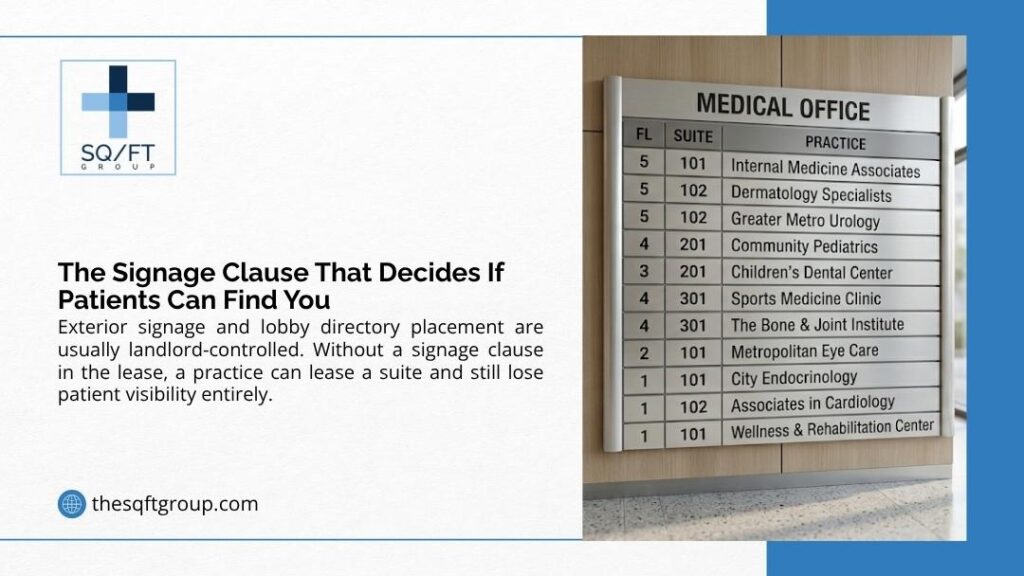
The landlord responsibilities medical office tenants overlook most often are not about HVAC or parking. They are about HIPAA access, medical waste, and ADA compliance, areas that standard commercial lease templates rarely address with enough specificity.
HIPAA, Access, and Privacy
Under HIPAA, the tenant, as the covered entity, holds the full compliance obligation. The landlord is not a business associate unless they perform services that directly involve patient health information.
The practical risk is real. A janitorial crew with unrestricted after-hours access to clinical areas can trigger a PHI exposure if patient records are not secured before entry. The lease must restrict landlord and vendor access to zones where patient data is present. Defining those zones starts with the HIPAA layout rules for clinical zones, which map where PHI can and cannot be exposed in your floor plan.
A termination clause that allows the practice to exit without penalty if the landlord violates HIPAA-related restrictions is worth negotiating into the document before the lease is finalized.
Medical Waste and Specialty Room Requirements
Medical waste is the tenant’s responsibility in virtually all commercial lease structures. Storage, separation, and disposal must go through a licensed provider in compliance with OSHA, EPA requirements, and applicable state law.
| Specialty Item | Responsibility | Lease Action Needed |
| Medical waste disposal | Tenant | Specific clause required |
| Dedicated sink plumbing | Negotiated | Address in the work letter |
| Sharps disposal | Tenant | Not in standard lease templates |
| Sterilization room infrastructure | Negotiated | Define in the TI scope |
Medical tenants should carry at least $1 million per incident in coverage, $2 million in aggregate, and a $5 million umbrella policy given the regulatory exposure that clinical operations create.
ADA and Patient Access
Updated ADA standards in 2026 require commercial property owners to audit physical access and accommodation processes. ADA compliance costs are not automatically allocated. Leases silent on this point create disputes years after the start date.
A practical split: common area ADA costs fall on the landlord as capital expenditures, and premises-level costs fall on the tenant. This allocation should be written into the lease before any signature goes on the document.
What to Do Before You Sign or Renew a Medical Office Lease
The landlord responsibilities medical office tenants need to confirm in writing before signing are exactly the terms that become most difficult to resolve after a dispute begins.
Questions to Confirm Before Signing
A pre-signing review should produce clear, written answers to each of the following:
- Who handles routine HVAC service, and who pays for full system replacement?
- What is the landlord’s required response time for emergency repairs?
- Are CAM charges capped, and does the tenant have audit rights?
- Who pays for ADA modifications to common areas?
- What are the restoration obligations at move-out?
- Is after-hours building access available, and at what cost?
- Are there restrictions on medical waste storage within the premises?
Clauses That Need Legal Review
These sections carry the highest financial and operational risk in any medical office lease:
- Maintenance and repair allocation by system
- Operating expense and CAM definitions, caps, and exclusions
- Landlord and vendor access provisions for clinical areas
- Tenant improvement and restoration language
- Permitted use clause, confirmed to cover all clinical operations
What to Negotiate, Not Assume
Tenant improvement allowance for dental offices and all other clinical practices follows the same logic: the landlord’s contribution is tied to lease length and is negotiable, not fixed.
CAM expense caps, HVAC replacement cost-sharing, access restrictions for clinical areas, and restoration waivers are all open for discussion at the lease stage.
These terms become significantly harder to change after the lease is executed.
Common Mistakes and Red Flags in Medical Office Leases
From our work with medical tenants and healthcare providers across the Northeast, these are the warning signs that most often reflect poorly allocated landlord responsibilities medical office tenants discover after move-in.
| Red Flag | Why It Matters | What to Ask |
| Vague repair language | Creates cost disputes after move-in | Get each system’s responsibility in writing |
| No CAM cap in the lease | Unlimited annual cost increases | Negotiate a 5% cap on controllable expenses |
| Unrestricted landlord access | PHI exposure risk | Add clinical area restriction clauses |
| No restoration clarity | Surprise removal costs at move-out | Confirm what must be restored and what stays |
| Undefined build-out scope | TI shortfall and overrun exposure | Agree on full scope before the lease is signed |
Vague Lease Language That Creates Disputes
Terms like “reasonable repairs” or “standard maintenance” create conflict because both parties read them differently, and courts often do too.
| Vague Term | Clear Alternative |
| “Reasonable repairs” | Named system list with a cost threshold |
| “Standard maintenance” | Specific trade and service frequency |
| “Landlord access upon notice” | Defined notice period with restricted clinical zones |
Budget Items That Catch Tenants Off Guard
CAM reconciliations typically arrive higher than the original estimate. Rent escalations compound over a 7 to 10 year medical office lease term. Restoration costs at move-out rarely receive a budget line from first-time medical tenants.
Request three years of historical CAM data from the landlord before the lease is signed. Negotiate a 5% to 7% annual cap on controllable expense increases and confirm that audit rights are written into the agreement.
Signs the Space May Not Fit Healthcare Operations
Parking requirements for medical offices are one of the most common mismatches between what a building offers and what a clinical operation needs. A space that looks attractive on paper can fail operationally before the first patient walks in. When a landlord cannot resolve those operational gaps, it may be a sign of when it’s time to relocate your practice rather than keep negotiating.
- Parking below 4 spaces per 1,000 square feet
- Electrical service insufficient for imaging or specialty equipment
- No accessible patient drop-off or covered entry area
- Plumbing that cannot support additional exam room fixtures
- Limited after-hours building access for extended clinic hours
Frequently Asked Questions
Who is responsible for HVAC in a medical office lease?
Routine service is typically the tenant’s responsibility. Full system replacement may fall on the landlord depending on the lease type. On a triple-net lease, tenants often bear both costs unless the lease explicitly states otherwise.
Are landlords responsible for roof repairs in medical office buildings?
In most gross and modified gross leases, landlords are responsible for roof repairs in medical office buildings. On NNN structures, roof obligations can shift to the tenant. This must be defined in the lease, not assumed by either party.
What costs are tenants usually responsible for in a medical office?
Interior maintenance, janitorial services, medical waste disposal, utilities, fixture repair, and build-out costs above the landlord’s TI allowance. On NNN leases, CAM charges, property taxes, and building insurance are added on top.
What should a tenant ask before signing a medical office lease?
Confirm all system-level responsibilities in writing, request three years of CAM history, verify parking ratios, confirm the permitted use clause covers all clinical operations, and review restoration obligations before the lease is executed.
A Final Note Before You Sign
Landlord responsibilities for medical office tenants are not automatic legal protections. They are negotiated terms written into a lease, or they do not apply. The same is true of lease assignment and landlord consent standards, which decide whether you can hand the space to a buyer or successor practice without an unreasonable fight.
Medical office leases run 7 to 10 years on average. What gets confirmed at the start defines the financial and operational reality for the entire term.
A practice that signs without full clarity on responsibility allocation faces years of potential cost disputes, compliance exposure, and operational problems that are very difficult to resolve mid-lease.
At SQ/FT Commercial Brokerage, our team works with healthcare providers and medical practice owners across New York, New Jersey, Connecticut, and the broader New England region.
From site selection to lease review, we help clients confirm that every responsibility, cost, and access term is clearly defined before any agreement is finalized.
If you are ready to lease, renew, or relocate a medical office, contact our team today.