

Relocating a medical practice is expensive, disruptive, and easy to put off, which is exactly why so many owners wait too long. The signs build up quietly until the space itself becomes the thing limiting your growth. This checklist is for practice owners, physician-partners, and administrators who suspect their location is holding them back and want to separate the problems that are fixable from the ones that mean it’s genuinely time to move.
Why the Decision Feels So Hard (and Why Waiting Costs You)
A relocation touches almost everything at once: lease economics, patient retention, staff, credentialing, and the day-to-day rhythm of care. So the instinct is to delay, renew the lease one more time, squeeze in one more provider, live with the parking complaints. A move of this size deserves a structured, evidence-based approach rather than a gut call, and the American Medical Association’s guidance on weighing significant practice changes is a useful reminder to treat these moments deliberately.
Staying in the wrong space rarely announces itself with a single crisis. The cost compounds slowly, patients who don’t rebook because parking is a hassle, a service line you can’t launch, operating expenses creeping up in an aging building. By the time the problem is obvious, you’ve already left money on the table for years.
Staying in the wrong space rarely announces itself with a single crisis. By the time the problem is obvious, you’ve already left money on the table for years.
7 Signs It’s Time to Relocate Your Medical Practice
No single sign below is proof on its own. But when several show up together, the location has usually become a ceiling.
1. You’ve Outgrown the Space (and Can’t Add Operatories or Exam Rooms)
The waiting room overflows at peak hours. You’d hire another provider or add a service line, but there’s physically nowhere to put them. When your schedule is capped by the number of rooms rather than by patient demand, you’re paying rent on a constraint. Reconfiguring can buy time, but if the walls won’t give, growth stops here.
2. Your Lease Terms No Longer Make Sense
A renewal arrives with a steep escalation, common-area maintenance charges that keep climbing, or a landlord unwilling to fund the tenant improvements a modern practice needs. Pull your current rent and compare it against real market rates for comparable medical space. Not every relocation happens by choice, sometimes lease expiration and building issues force the move, and it’s better to see that coming than to negotiate from a corner.
3. Patients Can’t Easily Find, Reach, or Park at You
Poor street visibility, awkward ingress and egress, too few parking spaces, no transit nearby, each adds friction that quietly suppresses new-patient volume. Established patients tolerate it; prospective ones simply choose the practice that’s easier to get to. Getting this right starts with choosing a location that matches your patient demographic and visibility needs.
If your office is creating friction, it may be time to review your options. Before deciding whether to renew, expand, relocate, or purchase, …
4. The Demographics Around You Have Shifted
Neighborhoods change. The payer mix, age profile, or growth trajectory around your building may have drifted away from your specialty’s ideal patient, while new residential and commercial development takes off across town. If the population that fills your schedule is aging out or moving out, the case for following them grows. This is why evaluating demographics, competition, and visibility before you commit matters as much for a relocation as for a first location.
5. The Building Is Aging, Non-Compliant, or Costly to Operate
Accessibility gaps that fall short of current ADA standards, a failing rooftop HVAC unit, electrical service that can’t support modern imaging or dedicated circuits, plumbing that won’t accommodate specialized rough-in, these are the expenses that don’t show on the rent line. When the cost to retrofit an old space starts to approach the cost of building out a better one, the math has already tipped. The real, often-hidden expenses live here: infrastructure and code-compliance upgrades, not the sticker on the lease.
6. You Can’t Recruit or Retain the Right Staff or Providers
Talent notices the building. A cramped, dated office, a difficult commute, or an area short on amenities can quietly cost you the associate or hygienist you were counting on. If facility quality or location keeps surfacing in exit conversations and recruiting stalls, the space is working against your team.
7. Growth Is Capped by the Location Itself, Not by Demand
You’re turning patients away, sitting on a service line you can’t launch, or watching competitors in better-sited spaces pull market share you should be winning. When demand clearly exists and only the location prevents you from meeting it, relocation stops being a risk and starts being the growth strategy.
Signs That Are Fixable Without Moving
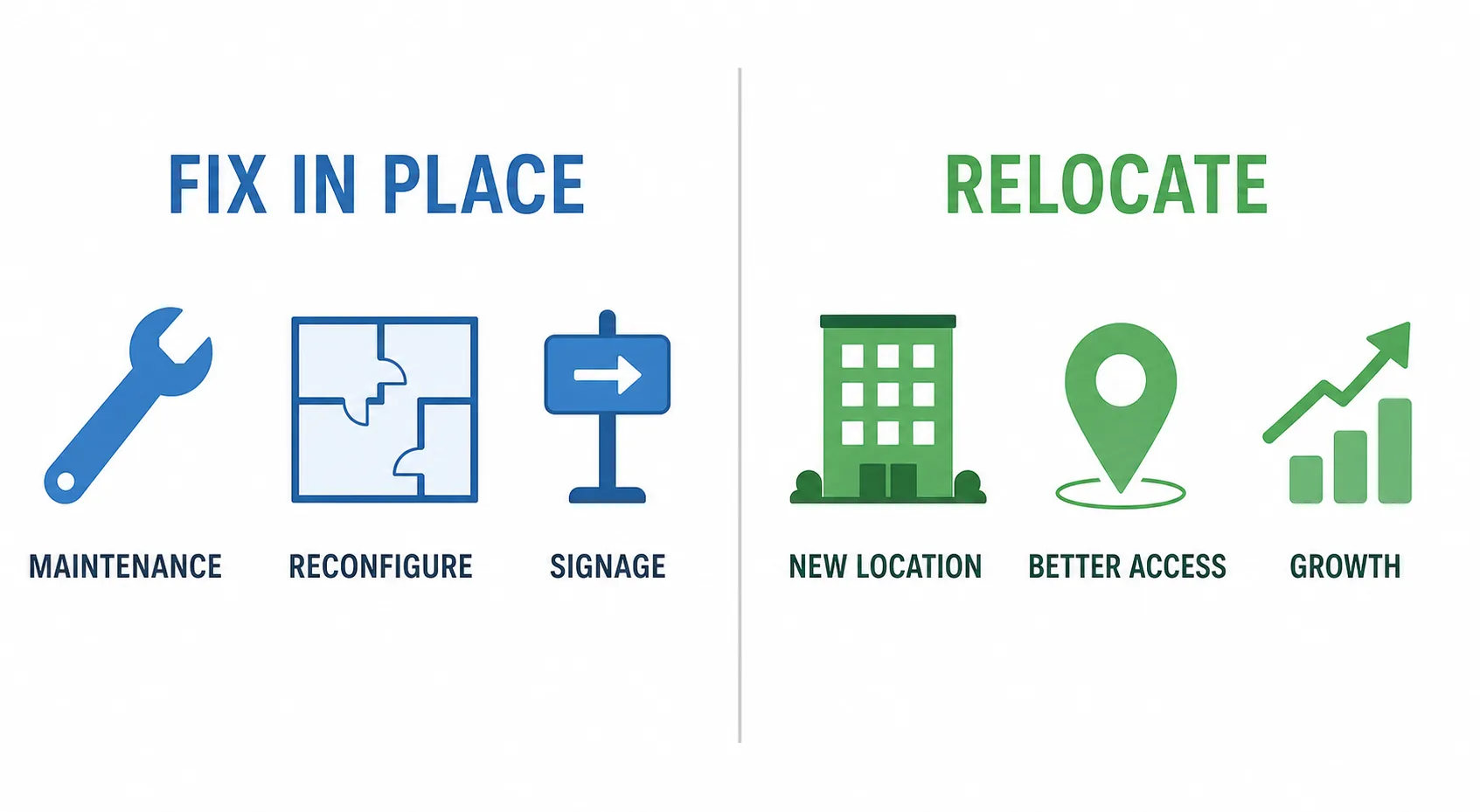
Not every warning sign means pack the boxes. Some are operational problems wearing a location’s clothing, and moving won’t solve them.
| Apparent problem | Fix to try before you move |
|---|---|
| A tough lease | Can often be renegotiated, especially if you have market comps and a credible willingness to leave. |
| A cramped feel | Sometimes yields to a reconfiguration: converting storage, reworking the front desk, or adding hours to spread demand. |
| Scheduling bottlenecks | Frequently trace back to front-desk workflow, not square footage. |
| Weak visibility | May respond to better exterior signage and a stronger local search presence before you conclude the address itself is the problem. |
Being honest about what’s fixable protects you from an unnecessary seven-figure decision, and makes the case for moving far stronger when it’s real.
The Hidden Costs to Weigh Before You Commit
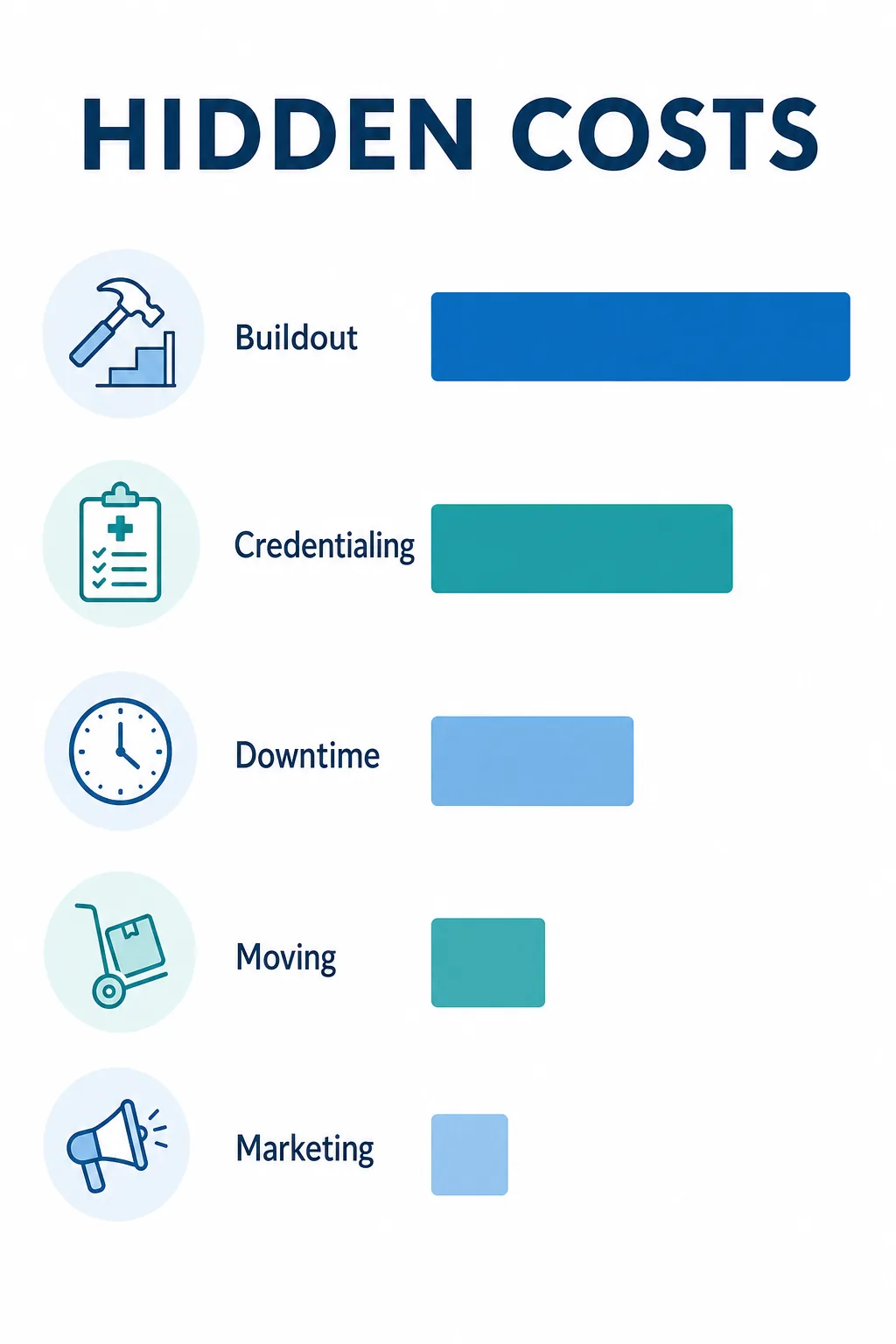
The rent difference is the easy number. The costs that surprise owners come from everything around the move. A tenant-improvement allowance rarely covers a full medical buildout; specialized plumbing rough-in, an electrical panel upgrade with dedicated circuits, HVAC or RTU capacity, and accessibility upgrades routinely push the real budget well past the headline figure.
Then there’s the disruption itself, downtime during the transition, transporting and recalibrating equipment, re-credentialing with payers at the new address, new signage and collateral, and a marketing push to announce the move. Patient continuity deserves particular attention: research on practice closures shows that older and long-established patients are the most disrupted when a practice’s location or availability changes, so continuity of care has to be planned, not assumed.
How to Protect Patient Retention During a Move
Attrition is the quietest cost of any relocation, and it’s largely preventable with a plan.
- Notify early and often. Give patients ample lead time by mail, email, phone reminders at visits, and signage in the current office.
- Update every digital touchpoint. Your website, Google Business Profile, insurance directories, and online listings should all reflect the new address before the first patient arrives there.
- Post clear signage at the old location so anyone who arrives out of habit finds you.
- Give staff a script. Front-desk and clinical teams should answer “where are you moving and when?” consistently and warmly.
- Transfer records compliantly and make continuity of care, not just logistics, the message patients hear.
A Simple Way to Pressure-Test the Decision
Before you sign anything, run the decision through three questions:
- Is the problem the space or the operation? If a workflow fix or lease renegotiation would resolve it, start there.
- Does a market analysis support demand elsewhere? Moving toward the right demographics and visibility is strategy; moving for a nicer lobby is not.
- Does the five-year cost of staying exceed the cost of moving? Include lost growth, rising operating costs, and retrofit spending, not just rent.
When the answers point toward relocating, the next step is a disciplined site-selection and market-analysis process rather than a lease you sign because it’s convenient.
Frequently asked questions
How do I know if I should relocate or just renovate my practice?
What does it really cost to relocate a medical practice?
How far in advance should I plan a medical practice move?
Will I lose patients if I move my practice?
The signs are cumulative. One alone rarely justifies a move, but several together, capped growth, a lease that no longer works, a building fighting your equipment and your recruiting, mean the location has become a ceiling. Before you commit, validate the decision with a market and site analysis, so the next address is the one that finally lets the practice grow.