

You are selling your practice, bringing on a partner, or moving into a larger suite, and your lease still has years to run. What happens to that lease often decides whether the transition closes cleanly or stalls at the finish line. The assignment clause is the mechanism that lets you hand the lease to someone else, and its wording controls how easy or painful that will be. This guide covers what a medical office lease assignment is, how it differs from a sublease, whether you stay on the hook afterward, and what to read before you sign.
What Is a Medical Office Lease Assignment?
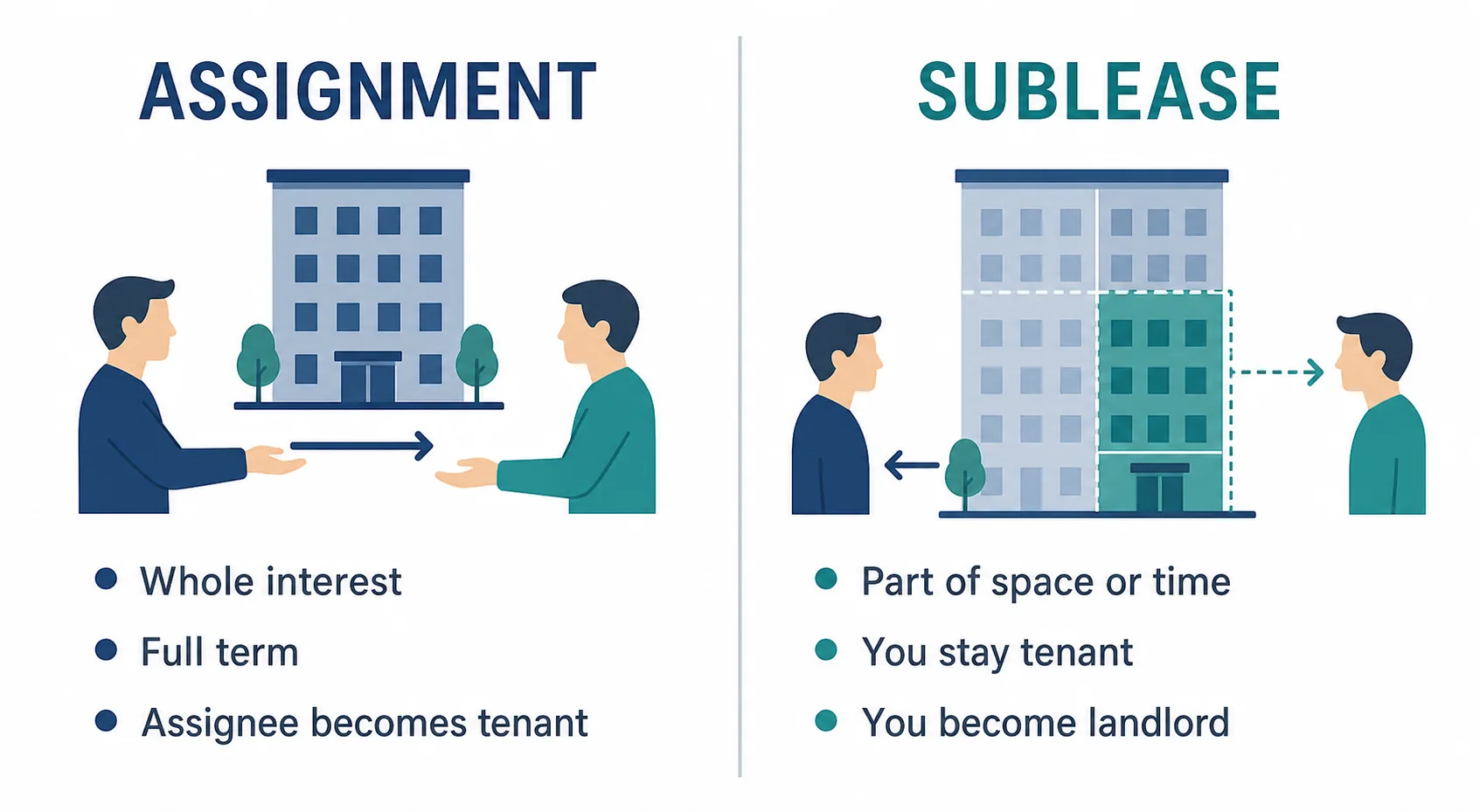
A lease assignment transfers your entire remaining interest in the lease to a new party, called the assignee. The assignee steps into your shoes for the balance of the term, taking on the rent, the obligations, and the rights that were yours. Once the assignment is complete and consent is granted, the assignee deals directly with the landlord as the tenant of record.
That is the plain answer to “what does an assignment of a lease mean?” You are not carving off a piece of the space or a slice of the term. You are conveying the whole thing.
Assignment vs. Sublease: The Distinction That Trips People Up
These two get confused constantly, and the difference matters legally and financially.
- Assignment transfers your whole interest for the full remaining term. The assignee becomes the tenant.
- Sublease transfers only part of the interest, either a portion of the space or a shorter slice of time. You remain the tenant and become a landlord to your subtenant.
If you sublease, you keep managing the relationship and stay directly responsible to the landlord for everything. If you assign, you are trying to exit. That difference in intent is why landlords scrutinize assignments so closely.
Can a Commercial Lease Even Be Assigned?
Yes, but almost never freely. Nearly every commercial lease requires the landlord’s written consent, and the lease’s assignment clause governs the terms of that consent. A lease that lets you assign without permission is rare. The real question is not whether you can assign, but under what conditions the landlord’s consent is given or withheld. You can see how this reads in an actual institutional document: a medical office building lease filed with the U.S. Securities and Exchange Commission spells out consent, assignment, and continuing-obligation language in the dense terms typical of these agreements.
Why Healthcare Tenants Assign a Lease
Assignment tends to surface at a handful of predictable moments in a practice’s life:
- Selling the practice. The buyer usually needs the existing location and its patient base, so the lease has to move with the sale.
- Retirement or exit. A departing owner hands the space to a successor.
- Partnership or entity restructuring. Adding a partner or converting to a professional corporation can require transferring the lease into a new entity.
- Group acquisition or roll-up. A group acquiring your practice will want the lease assigned to its entity.
- Relocation. Moving to a bigger suite while a long term remains on the old space.
- Exiting a build-out. Handing off a space that is mid-conversion.
For most of these, a clean right to assign is not a convenience, it is a valuation issue. A buyer paying for a dental or medical practice is largely paying for a location, its equipment, and its established patient flow. If the lease cannot be transferred, or the landlord can block or tax the transfer, the deal weakens. Working through this early is part of the full commercial real estate picture for a healthcare practice, not just the monthly rent.
Your leverage is set the day you sign the lease, not the day you decide to sell. By the time you have a buyer, the clause is fixed.
Are You Still Responsible After You Assign the Lease?
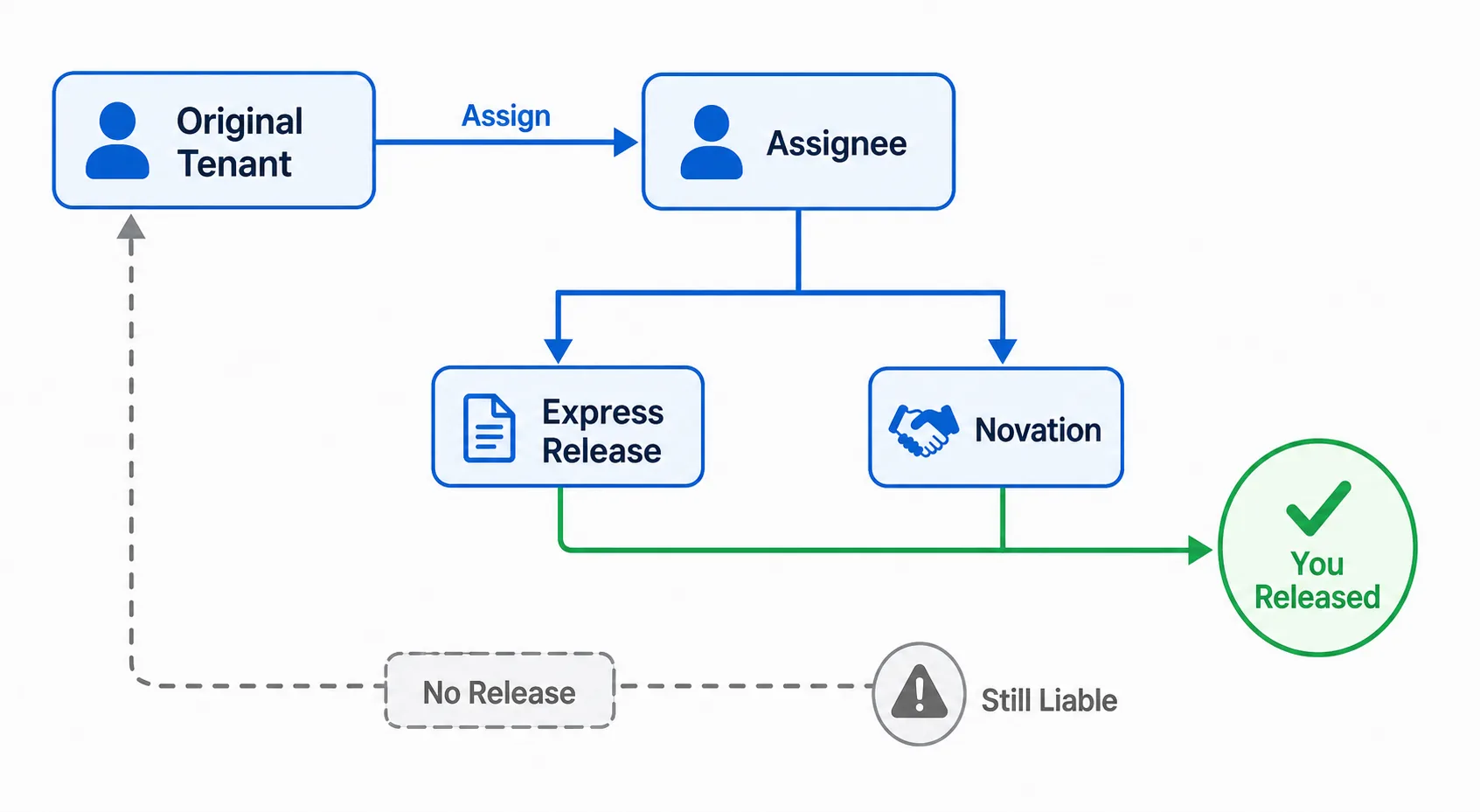
This is the question that keeps sellers up at night, and the honest answer is: usually, yes, at least secondarily. Getting landlord consent to an assignment does not by itself release you from liability.
Under the concept lawyers call privity of contract, you signed the original lease, so you remain a party to that contract even after someone else takes over the space. If the assignee stops paying rent or defaults, the landlord can often come back to you for the shortfall. Consent to assign is not the same thing as a release.
How to Actually Get Released
To cut your continuing exposure, negotiate for it explicitly. Ask for one of two things at the time of assignment:
- An express release of liability, in which the landlord agrees in writing to release you from further obligations, or
- A novation, which replaces the original lease obligation with a new one between the landlord and the assignee, extinguishing yours.
Neither is automatic, and many landlords resist. But if you do not ask, assume you stay on the hook for the remaining term. This continuing-obligation reality is exactly why the assignment and consent sections of institutional leases, like the SEC-filed medical office building lease, are written so carefully in the landlord’s favor.
What Happens to a Personal Guaranty
If you signed a personal guaranty when you took the space, that guaranty frequently survives the assignment unless it is explicitly terminated. A selling dentist or physician can transfer the lease, walk away from the practice, and still be personally guaranteeing rent for a tenant they no longer control. Read your guaranty carefully and make its release a condition of the assignment. It is one of the most overlooked traps in a practice sale.
Taking over a retiring physician’s lease? Before you sign anything, make sure you understand the lease assignment process, landlord approvals, …
The Assignment Clause: What to Read Before You Sign (or Sell)
Here is the uncomfortable truth: your leverage is set the day you sign the lease, not the day you decide to sell. By the time you have a buyer, the clause is fixed. So the terms below are worth fighting for up front.
“Sole Discretion” vs. “Not Unreasonably Withheld”
Assignment clauses usually condition consent one of two ways:
- Landlord’s sole discretion lets the landlord say no for any reason or no reason at all. This is the weakest position for a tenant.
- Consent not to be unreasonably withheld requires the landlord to have a legitimate, reasonable basis to refuse, typically tied to the assignee’s finances or intended use.
The second standard is meaningfully more protective and worth negotiating hard for. It is the difference between a landlord who must justify a refusal and one who can simply block your practice sale.
Recapture Rights
Some leases give the landlord a recapture right: instead of approving your assignee, the landlord can terminate the lease and take the space back. If your space has appreciated, the landlord may prefer to re-lease it at market rather than let you transfer it. Recapture can quietly kill a practice sale, so know whether your lease contains it.
Profit-Sharing and Excess Rent
Watch for clauses that let the landlord claim a share of any premium the assignee pays above your current rent. If your below-market lease is part of what makes your practice attractive, a profit-sharing clause can redirect that value to the landlord.
Permitted Transfers and Affiliate Carve-Outs
A well-negotiated lease includes permitted transfer language allowing assignment to a successor entity, a partnership, or a professional corporation without triggering the full consent process. If you expect to restructure your practice or sell to a group, these carve-outs are valuable.
Most of these terms are negotiable at signing, and each one is a lever. For a step-by-step tactical companion on securing them, see our guide to negotiating a dental office lease.
The Landlord Approval Process, Step by Step
When the time comes to assign, the process generally follows a predictable sequence:
- Submit a written request. You formally request consent and provide details on the proposed assignee, including financial statements.
- Landlord due diligence. The landlord evaluates the assignee’s creditworthiness, experience, and intended use of the space. For medical use, expect scrutiny of professional licensure and the specific clinical use.
- Consent and assignment documents. If approved, the parties sign a consent to assignment and an assignment-and-assumption agreement in which the assignee accepts the lease obligations.
- Estoppel and guaranty. The landlord may require an estoppel certificate confirming the lease status and, often, a new guaranty from the assignee.
- Coordinate with the sale closing. The assignment is timed to close alongside the practice sale so possession and ownership transfer together.
What Documents a Landlord Will Demand
Be ready to hand over, on the assignee’s behalf, items such as recent tax returns or financial statements, a business plan or practice overview, and proof of professional licensure for medical or dental use. Tenant quality genuinely drives landlord decisions here. Research published in the National Institutes of Health’s PubMed Central on medical service quality and office rent premiums links a tenant’s reputation and service quality to the rents landlords can command, which helps explain why landlords underwrite an incoming healthcare tenant so closely before consenting.
Anatomy of a Medical Office Lease Assignment Agreement
Searchers looking for a template, sample, or PDF deserve substance over a blank form. Here is what a real assignment agreement actually contains.
Core Provisions
- Parties and effective date identifying assignor, assignee, and (via consent) the landlord.
- Assignment of interest, the operative language transferring the lease.
- Assumption of obligations, in which the assignee agrees to perform all future lease duties.
- Representations and warranties about the lease status, defaults, and authority.
- Landlord consent block, where the landlord formally approves.
- Release or novation, if you negotiated one, addressing your continuing liability.
- Security deposit transfer, clarifying who holds or replenishes the deposit.
- Guaranty, covering whether a new guaranty is given and whether the old one is released.
Healthcare-Specific Add-Ons
Medical and dental assignments carry extra layers a generic office form will miss:
- Permitted-use consistency, confirming the assignee’s use (general medical, dental, specialty) fits the lease and the building.
- Compliance obligations for health, ADA, and biohazard or medical-waste requirements.
- Exclusive-use protections: if your lease granted an exclusive for your specialty, it must carry over to the assignee.
Where to Get the Right Document
Use a state-specific, attorney-reviewed agreement, not a generic download. A form labeled “California,” “2021,” or “2022” may not reflect your state’s requirements or the current terms of your actual lease. A template helps you understand the structure, but the document you sign should be drafted or reviewed against your specific lease and local law. The stakes, both liability and valuation, are too high for a one-size-fits-all form.
Assignment During a Build-Out: The Overlooked Scenario
Here is a situation almost no guide addresses: assigning a lease while the space is mid-fit-out. Picture a retail suite being converted to a dental office, with operatory plumbing roughed in, a new rooftop HVAC unit going in, an electrical panel upgrade underway, and an ADA restroom being built. If that lease is assigned before the work is finished, the assignment has to answer some pointed questions:
- Who owns the remaining tenant improvement allowance? Does the unspent allowance follow the space to the assignee, or is it forfeited?
- Who is responsible for open permits? Unfinished permits do not vanish; they carry liability to whoever holds the lease.
- Who closes out inspections? Incomplete inspection sign-offs can block a certificate of occupancy and delay opening.
An assignee taking a space mid-conversion inherits real obligations, not just a floor plan. Unfinished work and open permits transfer genuine risk. Build-out conversions also come with a long tail of costs that surprise first-time practice owners, from permit fees to change orders, so understanding what the improvement dollars actually cover is essential. Our deep dive on the tenant improvement allowance for dental offices breaks down the money at stake and how to protect it when a space and its build-out change hands.
Typical Lease Terms and How Long Assignment Rights Last
What is the typical lease term for office space? General office leases commonly run a few years, but medical and dental leases tend to run longer, often multiple years and sometimes a decade or more, because the heavy build-out investment needs a long runway to pay off. A practice that spends six figures on operatories is not signing a short lease.
That length is exactly why assignment rights matter so much in healthcare. A longer term means more remaining lease to transfer when you sell or move, and more value tied up in the space. The more term you have left, the more a strong assignment clause protects your ability to exit on your terms. (These ranges are general norms; your actual term is whatever your lease states.)
Assignment vs. Sublease vs. Subletting: Quick Comparison
| Assignment | Sublease / Subletting | |
|---|---|---|
| Interest transferred | Entire remaining interest | Part of the space or part of the term |
| Who is the tenant of record | The assignee | You remain the tenant |
| Your continuing liability | Usually stays unless you get a release or novation | You stay fully liable to the landlord |
| Best used when | Selling, retiring, permanently exiting | Temporary excess space, short-term downsizing |
“Sublease” and “subletting” describe the same thing: you stay in the lease and rent to someone else. Assignment is how you try to leave it entirely.
How SQFT Group Helps
SQFT Group advises healthcare and dental tenants on the lease terms that decide a practice’s future, including assignment rights, releases and novations, guaranty exposure, and tenant-improvement negotiation. Whether you are signing a first lease and want strong exit rights, or you are mid-sale and need a clean transfer, getting the language right protects both your liability and your practice’s value. Explore more of our guidance and current listings through our commercial real estate resources for healthcare tenants.