

If you are opening or relocating a dental practice, one of the most important lease terms you will negotiate is the tenant improvement allowance for dental offices.
This guide covers how TI allowances work, what numbers are realistic, how to negotiate effectively, and what happens when the allowance does not cover everything.
What Is a Tenant Improvement Allowance for Dental Offices?
A tenant improvement allowance (TIA) is a sum a landlord offers to a tenant to help cover the cost of customizing a commercial space before move-in.
It is typically expressed as a dollar amount per square foot and paid out either directly to contractors or reimbursed to the tenant upon submission of receipts.
For dental offices, this matters more than in most commercial categories. A standard office tenant might need new flooring, paint, and partitions.
A dental tenant needs plumbing for multiple operatories, medical-grade electrical systems, lead-lined walls for X-ray rooms, specialized cabinetry, and a dedicated HVAC setup.
The gap between what a landlord considers a standard build-out and what a dental practice actually requires is large.
The tenant improvement allowance for dental offices is a critical negotiation point that affects your total project cost from day one.
How Much Is a Typical Tenant Improvement Allowance for Dental Offices?
TI allowances vary by market, landlord, property class, and lease term. In general commercial real estate, allowances for standard office space range from $30 to $60 per square foot. Dental offices regularly require more, and experienced dental tenants know to negotiate accordingly.
| Market Type | Typical TI Allowance per sq ft (2026 ranges) | Notes/Why |
| Class A urban commercial | $50 – $100+ | Premium urban spaces often offer higher allowances if lease terms are long or credit strong; medical needs push these higher than standard office. |
| Medical office / healthcare (incl. dental) | $50 – $100 | Healthcare/medical spaces generally secure above‑average TI dollars due to specialized build‑outs. |
| Suburban commercial strip | $30 – $70 | Suburban areas vary widely with local demand and vacancy; still often higher than basic retail because of professional use. |
| Secondary markets | $25 – $60 | Smaller towns or less competitive markets typically yield lower TI offers. |
| Raw, shell, ground‑up space | $60 – $120+ | If space is an unfinished “vanilla shell,” landlords often provide higher allowances to attract tenants willing to invest in a full build‑out. |
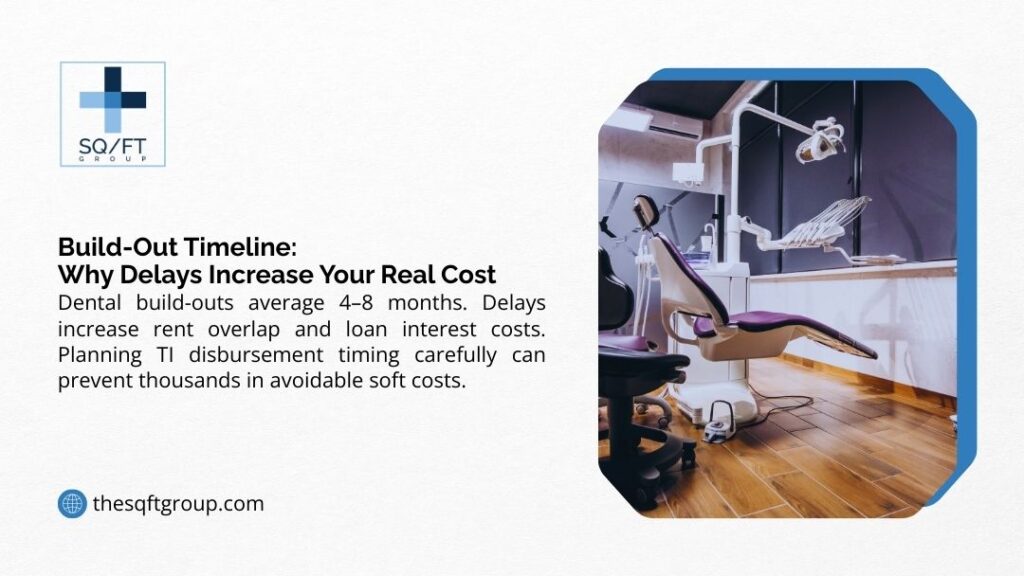
Dental office build-out cost per square foot in the US typically falls between $150 and $350 depending on location, finish level, and scope of work. That means even a generous TI allowance often covers only a portion of total construction costs.
The gap between the allowance and actual build-out cost is called the overage, and the tenant is responsible for it. Knowing that gap before you sign is essential.
What Does a Tenant Improvement Allowance for Dental Offices Cover?
Landlords generally allow TI funds to be used for permanent improvements to the space. What qualifies varies by lease language, so reading the TIA clause carefully matters.
| Typically Covered | Typically Not Covered |
| Plumbing rough-in and operatory lines | Dental equipment (chairs, units, X-ray machines) |
| Electrical upgrades and panel work | Loose furniture and décor |
| HVAC modifications | Technology and software |
| Lead shielding for X-ray rooms | Signage (sometimes) |
| Flooring, ceilings, and walls | Moving costs |
| Sterilization room build-out | Equipment installation labor (sometimes) |
| Reception and waiting area construction | Working capital |
From our work with healthcare tenants across the Northeast, one of the most common mistakes is assuming dental equipment is covered by the TI allowance. It almost never is.
Equipment is treated as personal property, not a permanent improvement to the space, so it falls outside what most landlords will fund.
How Landlords Structure TI Payments
The payment structure of a tenant improvement allowance for dental offices varies by deal. Three formats are most common:
Landlord-managed build-out:
The landlord hires the contractor and manages construction directly. The tenant has input on finishes but less control over the process. This works in favor of the landlord in terms of cost control.
Tenant-managed with reimbursement:
The tenant hires the contractor, manages the project, and submits invoices to the landlord for reimbursement up to the agreed amount. This gives the tenant more control but requires upfront capital.
Rent credit structure:
Instead of a cash payment, the landlord offers rent abatement. Free rent for a set period at the start of the lease. This is effectively the same value but structured differently and does not help with construction cash flow.
When buying or leasing a dental office space, the payment structure can affect your financing needs significantly. A reimbursement model requires you to fund construction first, which may require a line of credit or SBA loan bridge.
How to Negotiate a Better Tenant Improvement Allowance
Landlords set their initial TI offer based on market norms and their own cost targets. That number is rarely their ceiling. Negotiation is expected, and dental tenants who come prepared tend to get better outcomes.
| Negotiation Factor | How It Helps You |
| Longer lease term (10+ years) | Landlord recovers TI cost over more years |
| Strong credit profile or practice history | Reduces landlord risk, increases flexibility |
| Detailed build-out scope and cost estimates | Shows professionalism, anchors negotiation |
| Competitive alternatives (other sites) | Creates urgency on landlord’s side |
| Early lease signing (high-vacancy building) | Landlord more motivated to fill space |
How to negotiate a dental office lease effectively comes down to preparation. Landlords respond to tenants who understand construction costs, know their market, and can back up their ask with real numbers. A vague request for “more TI” rarely moves the needle.
A detailed scope showing $200 per square foot in required work, compared to a $70 per square foot offer, makes the gap concrete and negotiable.
Lease term is the single biggest lever. A five-year lease limits a landlord’s willingness to invest. A ten or fifteen-year lease with renewal options changes the math entirely.

Space Size and Its Effect on TI Allowance
The size of your practice affects both the total TI amount you need and how landlords frame their offer. A $90 per square foot allowance looks very different on 1,500 square feet versus 3,500 square feet.
How much space you need for a dental practice depends on your operatory count, patient flow model, and staffing. Most general practices operate between 1,200 and 2,500 square feet. Specialty practices, orthodontics, and oral surgery often require more.
The larger the space, the larger the absolute dollar value of the TI allowance, even at the same per-square-foot rate.
This is worth factoring into site selection.
For example, a location that offers $80 per square foot on 2,000 square feet gives you $160,000 toward construction. The same rate on 1,500 square feet gives you $120,000. That $40,000 difference has real implications for your overage.
When the TI Allowance Is Not Enough
In most dental build-outs, the allowance covers a meaningful portion of costs but not all of them. The overage needs to come from somewhere.
Common sources include:
| Funding Source | Notes |
| SBA 7(a) or 504 loan | Common for dental practice financing |
| Practice acquisition loan | Can include build-out costs in some structures |
| Equipment financing | Covers equipment, freeing TI for construction |
| Personal capital | Used to bridge reimbursement timing gaps |
| Landlord loan / tenant improvement loan | Some landlords offer above-standard TI at higher interest |
The SBA 504 loan program, administered through the U.S. Small Business Administration, is one of the most frequently used tools for dental practice real estate and build-out financing.
It offers below-market fixed rates and long terms specifically suited to owner-occupied commercial projects.
Frequently Asked Questions
Is the tenant improvement allowance for dental offices taxable income?
Generally yes, in part. TI allowances used for permanent improvements to leased space are typically not taxable to the tenant when used for qualifying build-out costs.
However, any portion not spent on permanent improvements, or received as a cash payment for other purposes, may be treated as taxable income.
A tax professional familiar with dental practice accounting should review the specifics of your lease structure.
Can I keep unused TI allowance at the end of the project?
In most lease agreements, no. Unused TI funds revert to the landlord. This reinforces the importance of accurate cost estimation before you negotiate the allowance figure, asking for too little leaves money on the table, and unused funds do not carry over.
Does a higher TI allowance mean higher rent?
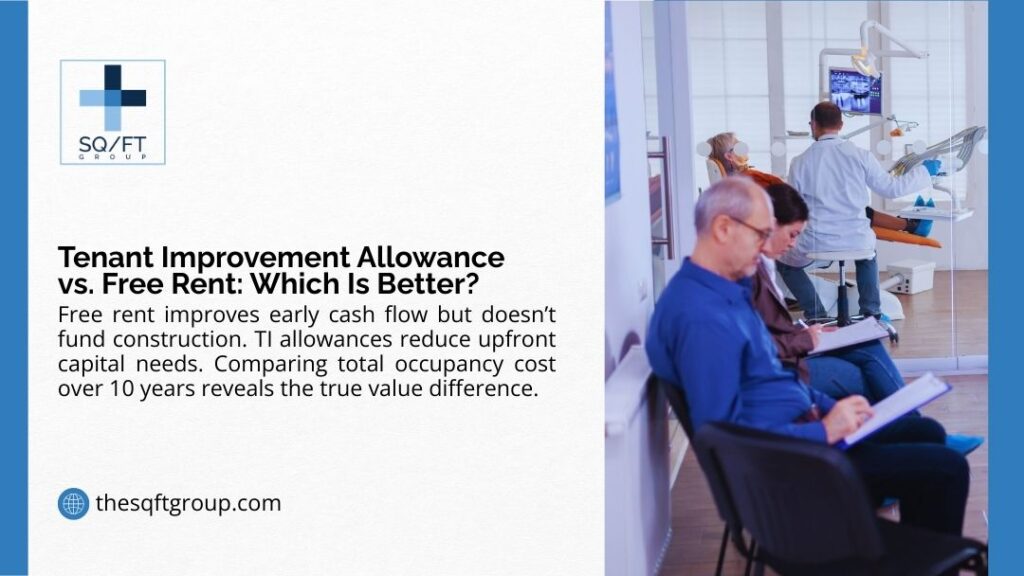
Often yes, at least indirectly. Landlords factor TI costs into their return on investment calculations. A larger allowance may be offset by a slightly higher base rent or a longer required lease term. The key is to evaluate the total cost of occupancy, not just the rent line.
Final Note
The tenant improvement allowance for dental offices is one of the most negotiable and most consequential terms in any dental practice lease.
The difference between a well-negotiated TI and an under-negotiated one can run into six figures on a standard build-out. The landlord’s opening offer is a starting point, not a final answer.
SQ/FT Commercial Brokerage works with healthcare tenants across New York, New Jersey, and Connecticut on exactly these negotiations.
From our experience across dozens of dental and medical office transactions, the team understands what is realistic in each market and how to structure deals that protect the tenant’s build-out budget from the start.